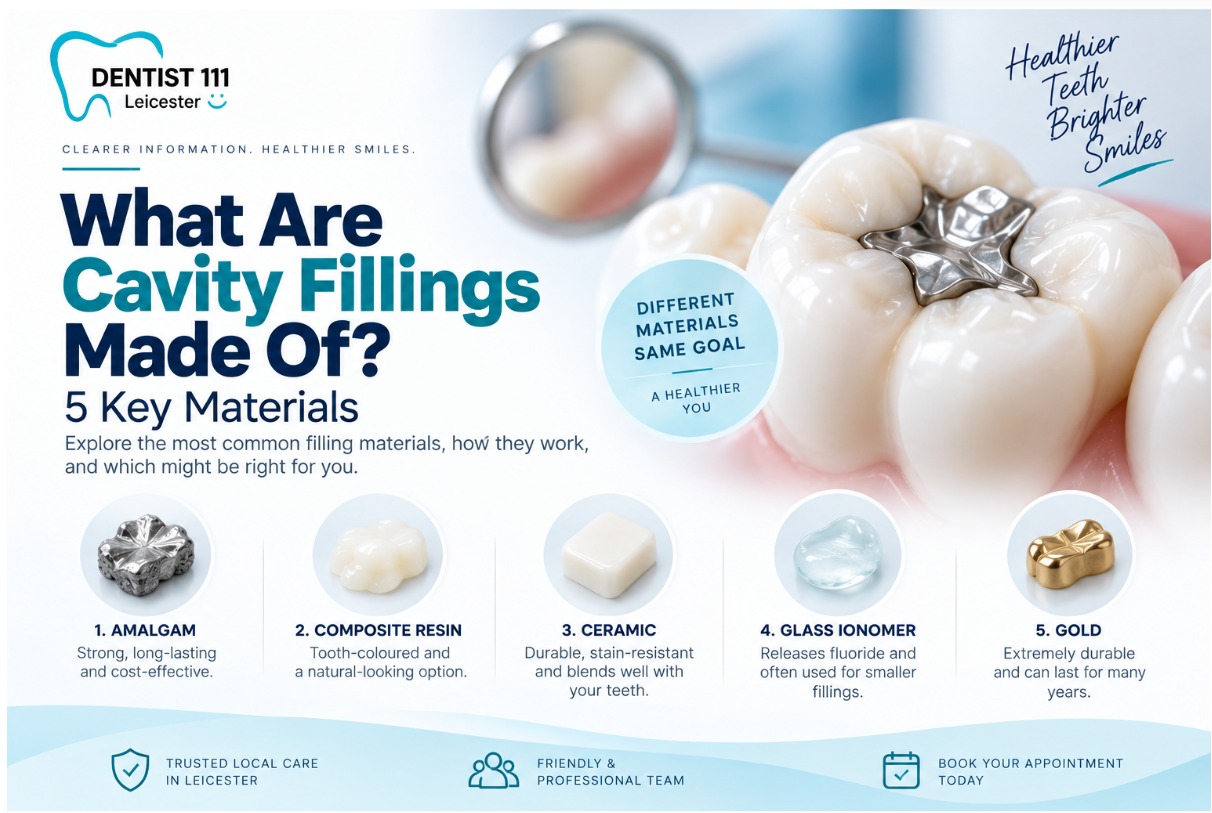
What Are Cavity Fillings Made Of? 5 Key Materials
Cavity fillings can be made from 5 main types of materials: composite resin, dental amalgam, glass ionomer, ceramic and gold-containing alloys. Composite resin is made from a resin matrix mixed with inorganic fillers, while dental amalgam combines elemental mercury with an alloy of silver, tin and copper. Glass ionomer uses aluminosilicate glass and polymeric acid. Ceramic and gold-based materials are generally used for restorations made outside the tooth before they are fitted.
What Are Cavity Fillings Made Of?
Cavity fillings are made from different restorative materials, with composite resin, amalgam, glass ionomer, ceramics and metal alloys representing the main material groups.
| Material | Main composition | Typical restoration type |
| Composite resin | Polymerisable resin matrix + inorganic fillers | Direct |
| Dental amalgam | Elemental mercury + silver, tin and copper alloy | Direct |
| Glass ionomer | Aluminosilicate glass + polymeric acid | Direct |
| Ceramic | Dental ceramic materials | Generally indirect |
| Gold alloy | Gold + other metals | Indirect |
The American Dental Association classifies resin-based composites, amalgam and glass ionomer among direct restorative materials. Ceramics and noble metal alloys are among the materials used for indirect restorations. CAD/CAM technology can blur this distinction because some ceramic restorations can be fabricated in a dental practice.
The material composition is therefore the key difference between the main types of dental fillings.
What Are Composite Fillings Made Of?
Composite fillings are made from a polymerisable resin matrix, inorganic filler particles and a coupling agent.
What Is Inside a Composite Filling?
A resin-based composite contains 3 main components:
- Resin matrix: A polymerisable organic material forming the continuous matrix.
- Inorganic fillers: Particles such as glass or silica incorporated into the resin.
- Coupling agent: A component that connects the filler particles with the resin matrix.
The combination produces the resin-based composite used for direct tooth-coloured restorations. The American Dental Association identifies resin-based composites as direct restorative materials.
What Are White Fillings Made Of?
White fillings are commonly made from tooth-coloured composite resin containing a resin matrix and inorganic fillers.
The term “white filling” describes the appearance rather than one specific chemical composition. Glass ionomer can also be tooth-coloured, but its composition is based on aluminosilicate glass and polymeric acid rather than a resin matrix.
What Is Dental Amalgam Made Of?
Dental amalgam is made from elemental mercury and a powdered alloy containing silver, tin and copper.
Approximately 50% of dental amalgam is elemental mercury by weight. The mercury reacts with and binds the alloy particles to form the hardened amalgam restoration.
Dental amalgam is often called a silver filling because of its appearance, but it is not made from pure silver. The material contains mercury together with the metallic alloy.
What Are Glass Ionomer Fillings Made Of?
Glass ionomer fillings are made from aluminosilicate glass powder and polymeric acid.
These components react during the setting process to form the hardened material. Glass ionomer therefore has a different composition from composite resin.
Composite contains a polymerisable resin matrix and inorganic fillers, whereas glass ionomer contains glass powder and polymeric acid. The American Dental Association includes glass ionomer among direct restorative materials.
What Are Ceramic and Porcelain Fillings Made Of?
Ceramic restorations are made from dental ceramic materials such as porcelains, glass-ceramics and polycrystalline ceramics.
Porcelain is a type of ceramic material used in dentistry. Zirconia is another dental ceramic used for restorative applications. The American Dental Association identifies silicate glasses, porcelains, glass-ceramics and polycrystalline ceramics as dental ceramic materials.
Ceramic restorations are generally classified as indirect restorations, although CAD/CAM systems allow some ceramic restorations to be designed and fabricated in a dental practice. Examples include ceramic inlays and onlays.
Are Gold Fillings Made From Pure Gold?
Gold dental restorations are made from gold-containing alloys rather than pure gold.
Gold is combined with other metals to produce an alloy with properties suitable for dental restoration. The exact composition varies between dental alloys.
The American Dental Association classifies gold-containing noble-metal alloys among indirect restorative materials. Gold alloys can be used for restorations such as inlays and onlays.
How Do Cavity Filling Materials Differ?
Cavity filling materials differ mainly in composition, appearance and restoration type.
| Material | Main composition | Typical appearance | Restoration type |
| Composite resin | Resin matrix + inorganic fillers | Tooth-coloured | Direct |
| Dental amalgam | Mercury + silver, tin and copper alloy | Silver/metallic | Direct |
| Glass ionomer | Aluminosilicate glass + polymeric acid | Tooth-coloured | Direct |
| Ceramic | Dental ceramic materials | Tooth-coloured | Generally indirect |
| Gold alloy | Gold + other metals | Gold/metallic | Indirect |
The principal material distinction is straightforward: composite is resin-based, amalgam is mercury-and-metal based, glass ionomer is glass-and-polymeric-acid based, ceramic is ceramic-based, and gold restorations use gold-containing alloys.
FAQs
What is a silver filling made of?
A silver filling is dental amalgam, which contains elemental mercury combined with an alloy containing silver, tin and copper. Approximately 50% of amalgam is mercury by weight.
Are cavity fillings made of plastic?
Some cavity fillings contain polymer-based resin, but not all filling materials are resin-based. Composite fillings use a polymerisable resin matrix with inorganic fillers, while amalgam, glass ionomer, ceramic and gold-containing restorations have different compositions.
Are all cavity fillings made from the same material?
No. Dental restorations use different material groups, including resin-based composites, amalgam, glass ionomer, ceramics and metal alloys.
Is porcelain the same as composite filling material?
No. Porcelain is a ceramic material, while composite contains a polymerisable resin matrix combined with inorganic fillers.
Related Post
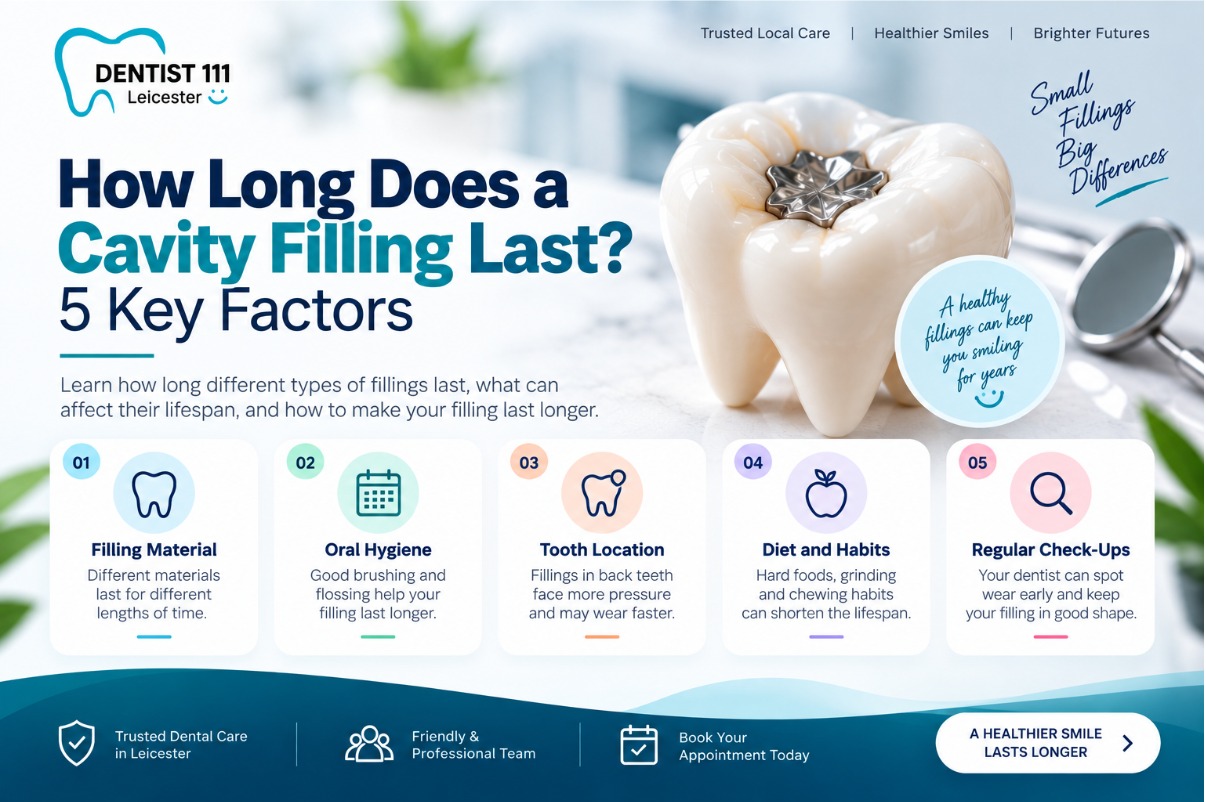
Dental fillings can last anywhere from several years to two decades or more, depending on the material, filling size, tooth location, biting forces, oral hygiene and restoration quality.

Find out how much a dental filling costs on the NHS in England in 2026, whether you pay for each filling, how white fillings are charged, who qualifies for free treatment, and how NHS costs compare with private fillings.