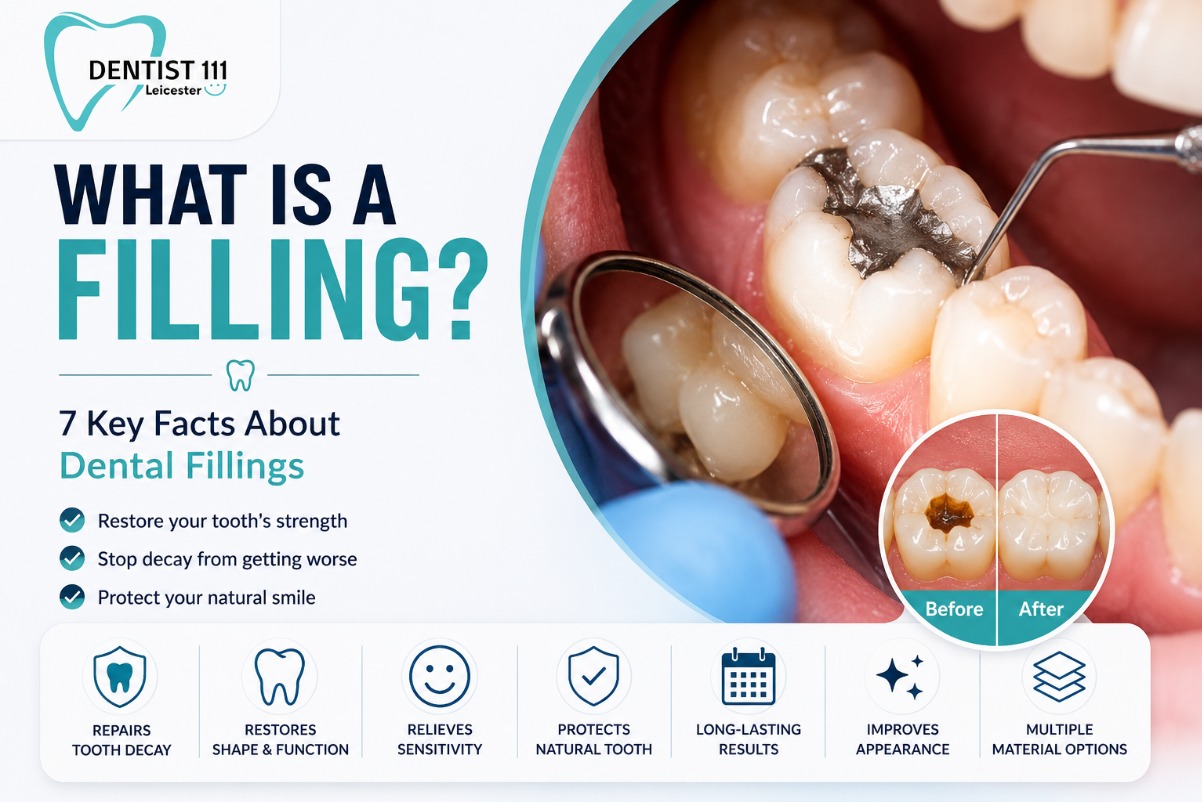
What Is a Filling? 7 Key Facts About Dental Fillings
A dental filling is a restorative treatment that replaces tooth structure lost through decay or minor damage. It restores the affected tooth’s shape, structure, and chewing function while preserving healthy natural tooth structure. This guide explains when fillings are used, how they repair cavities, which materials are available, and when a filling is not sufficient. It also covers what to expect after treatment and how long fillings can last.
What Is a Dental Filling?
A dental filling is a restorative treatment that replaces tooth structure lost through decay or minor damage. It restores the affected tooth’s shape, structure, and function while preserving remaining healthy tooth structure. Common materials include composite resin, amalgam, gold, and ceramic.
Tooth decay damages enamel and dentine when acids produced by oral bacteria remove minerals from the tooth. Continued mineral loss can create a cavity, leaving a physical defect in the tooth. A dentist removes the damaged tissue before restoring the affected area with filling material.
Dental fillings can restore localised tooth structure affected by cavities, decay, or selected minor damage. Material selection depends on tooth location, restoration size, functional demands, and aesthetic requirements.
For decay-related tooth damage in Leicester,filling treatment provides a local restorative option following professional assessment.
What Is the Difference Between a Cavity and a Filling?
A cavity is a physical defect in a tooth caused by tooth decay, while a filling is restorative material used to repair that defect. Tooth decay is the disease process that causes mineral loss. A cavity forms when this process progresses to a physical breakdown of tooth structure.
Tooth decay develops when acids produced by oral bacteria remove minerals from enamel. Continued mineral loss can weaken enamel and eventually form a cavity. Early tooth decay can exist without symptoms, so the absence of pain does not confirm that a tooth is healthy.
Term | Meaning | Clinical role |
Tooth decay | Disease process causing mineral loss | Damages tooth structure |
Cavity | Physical defect caused by advanced decay | Represents lost tooth structure |
Dental filling | Restorative material placed into a cavity | Restores tooth structure and function |
A dentist identifies decay through clinical examination and, when indicated, dental X-rays. A filling is commonly used when a cavity requires restorative treatment, while early non-cavitated decay can sometimes receive non-restorative management.
In simple terms, tooth decay causes the damage, a cavity is the resulting defect, and a filling repairs the affected area.
What Does a Dental Filling Do?
A dental filling replaces lost tooth structure, restores the tooth’s shape, and supports normal chewing function. It also restores the contour of the treated area and protects the remaining tooth structure.
A dentist removes decayed tissue before placing the filling material. The restoration occupies the space created by tooth decay. Its shape is adjusted to restore the tooth’s contours and contact with neighbouring teeth.
Dental fillings provide 4 main functions:
- Replace lost enamel or dentine.
- Restore the tooth’s natural shape.
- Support normal biting and chewing.
- Seal the treated area with restorative material.
A filling does not prevent future decay. New decay can develop around an existing restoration when plaque and frequent sugar exposure contribute to further mineral loss.
When Is a Filling Used?
A dental filling is used when tooth decay or minor structural damage creates a restorable area of lost tooth structure. A dentist determines suitability through clinical examination and, where clinically indicated, dental X-rays.
Common situations include:
- Tooth decay — acid-related damage removes enamel or dentine and creates a cavity.
- Minor tooth damage — selected small chips or defects can be restored with filling material.
- Localised tooth wear — limited structural loss can sometimes receive restorative treatment.
- Existing restoration damage — a defective filling can require repair or replacement after clinical assessment.
Pain is not required for a filling to be necessary. Early or moderate tooth decay can remain asymptomatic while structural damage progresses.
A dentist assesses the cavity’s depth, size, location, and remaining healthy tooth structure before selecting treatment. Small-to-moderate defects commonly remain suitable for restorative treatment, while extensive damage can require another approach.
How Does a Dental Filling Repair a Tooth?
A dental filling repairs a tooth by removing decayed tissue and replacing the resulting space with restorative material. The dentist then shapes and finishes the restoration to restore the tooth’s structure, function, and bite.
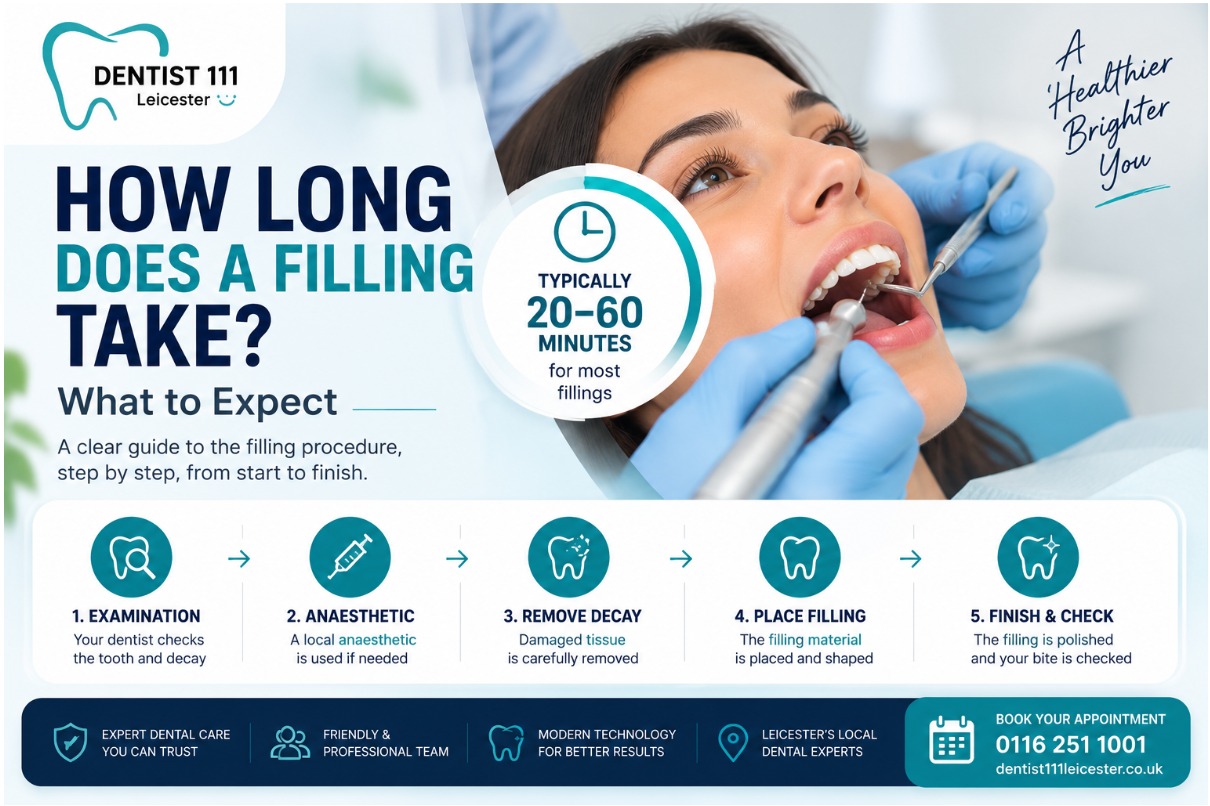
The filling procedure generally follows these steps:
- Examine the tooth to assess the cavity and remaining healthy structure.
- Apply local anaesthetic, where required, to control treatment discomfort.
- Remove decayed tissue from the affected area.
- Prepare the cavity so the restorative material can be placed securely.
- Place the filling material into the prepared area.
- Cure composite resin, where composite material requires light activation.
- Shape and finish the restoration to match the tooth’s contours.
- Check the bite so the restored tooth contacts opposing teeth correctly.
The procedure restores lost tooth structure rather than regenerating natural enamel or dentine. The exact technique varies according to the material used, cavity location, and extent of tooth damage.
What Are Dental Fillings Made Of?
Dental fillings are made from restorative materials selected according to the tooth’s location, damage, functional demands, and aesthetic requirements. Common materials include composite resin, amalgam, gold, and ceramic.
Filling material | Main attributes | Common application |
Composite resin | Tooth-coloured, adhesive, aesthetic | Visible teeth and selected posterior restorations |
Amalgam | Strong, durable, metal-based | Selected load-bearing posterior teeth |
Gold | Highly durable, custom-made | Selected restorations requiring high longevity |
Ceramic | Tooth-coloured, aesthetic, wear-resistant | Selected larger restorations |
Composite resin contains a resin matrix and inorganic filler particles. Its tooth-coloured appearance makes it suitable when restoration visibility matters.
Amalgam contains a mixture of metals, including silver, tin, copper, and mercury. Its strength has made it an established restorative material for posterior teeth.
Gold and ceramic provide alternative restorative properties. Gold offers high durability, while ceramic provides a tooth-coloured restoration with aesthetic characteristics.
Material selection remains a clinical decision based on the individual tooth and restoration requirements. Detailed differences between these materials depend on factors such as durability, appearance, cost, and restoration size.
When Is a Filling Not Enough?
A filling is not enough when decay or structural damage prevents predictable restoration with a direct filling. Deep decay involving the dental pulp can require endodontic treatment, while extensive damage can make a tooth unrestorable.
The treatment decision depends on 4 clinical factors:
- Decay depth — extensive decay can extend toward the dental pulp.
- Remaining tooth structure — insufficient healthy structure can limit restoration.
- Pulp condition — inflammation or infection can require endodontic treatment.
- Tooth restorability — extensive fractures or structural loss can prevent predictable restoration.
A filling restores localised tooth structure loss. Root canal treatment treats disease involving the dental pulp while retaining the natural tooth when the tooth remains restorable.
When pulp involvement requires endodontic treatment, root canal treatment can preserve a restorable natural tooth.
When Is a Filling Used?
A dental filling is used when tooth decay or localised structural damage creates a tooth defect suitable for direct restoration. A dentist assesses the tooth through clinical examination and uses dental X-rays when additional diagnostic information is indicated.
Common situations include:
- Tooth decay — acid-related mineral loss can create cavities in enamel or dentine.
- Minor tooth damage — selected small chips can receive direct restorative treatment.
- Localised tooth wear — limited structural loss can sometimes receive restoration.
- Defective restorations — worn, fractured, or decayed fillings can require repair or replacement.
Pain is not required for tooth decay to require assessment. Early decay can remain asymptomatic, so the absence of pain does not exclude disease.
A dentist considers the cavity’s depth, location, size, and remaining healthy tooth structure when selecting treatment.
What Can You Expect After Getting a Filling?
After getting a filling, temporary sensitivity or a slightly different bite can occur, particularly when the tooth has undergone restorative treatment. Sensitivity can involve cold drinks, hot foods, or pressure during chewing. A 2023 systematic review analysed 25 randomised controlled trials involving postoperative sensitivity after composite restorations.
An uneven bite can indicate that the restoration contacts the opposing tooth prematurely. A dentist can check and adjust the filling when the bite remains uncomfortable. Persistent, worsening, or severe pain requires dental assessment because it can indicate an underlying problem rather than routine post-treatment sensitivity.
How Long Does a Dental Filling Last?
A dental filling can last many years, but its survival varies by material, restoration size, tooth location, biting forces, and patient risk factors. Research shows that restoration longevity varies substantially between clinical situations.
A 2025 systematic review found median survival exceeding 16 years for amalgam and approximately 11 years for composite resin in adult posterior teeth. These figures describe study populations and do not represent a guaranteed lifespan for an individual filling.
Larger restorations, higher caries risk, heavy biting forces, and bruxism can increase failure risk. Research on posterior composite restorations also identifies caries and fracture among the main causes of restoration failure.
Fillings can require replacement when wear, fracture, or recurrent decay affects the restoration or surrounding tooth structure. Regular dental examinations allow these changes to be assessed clinically.
Related Post
Find out when you can eat after a filling, how long dental numbness usually lasts, which foods are safest, and what to avoid while your tooth settles.